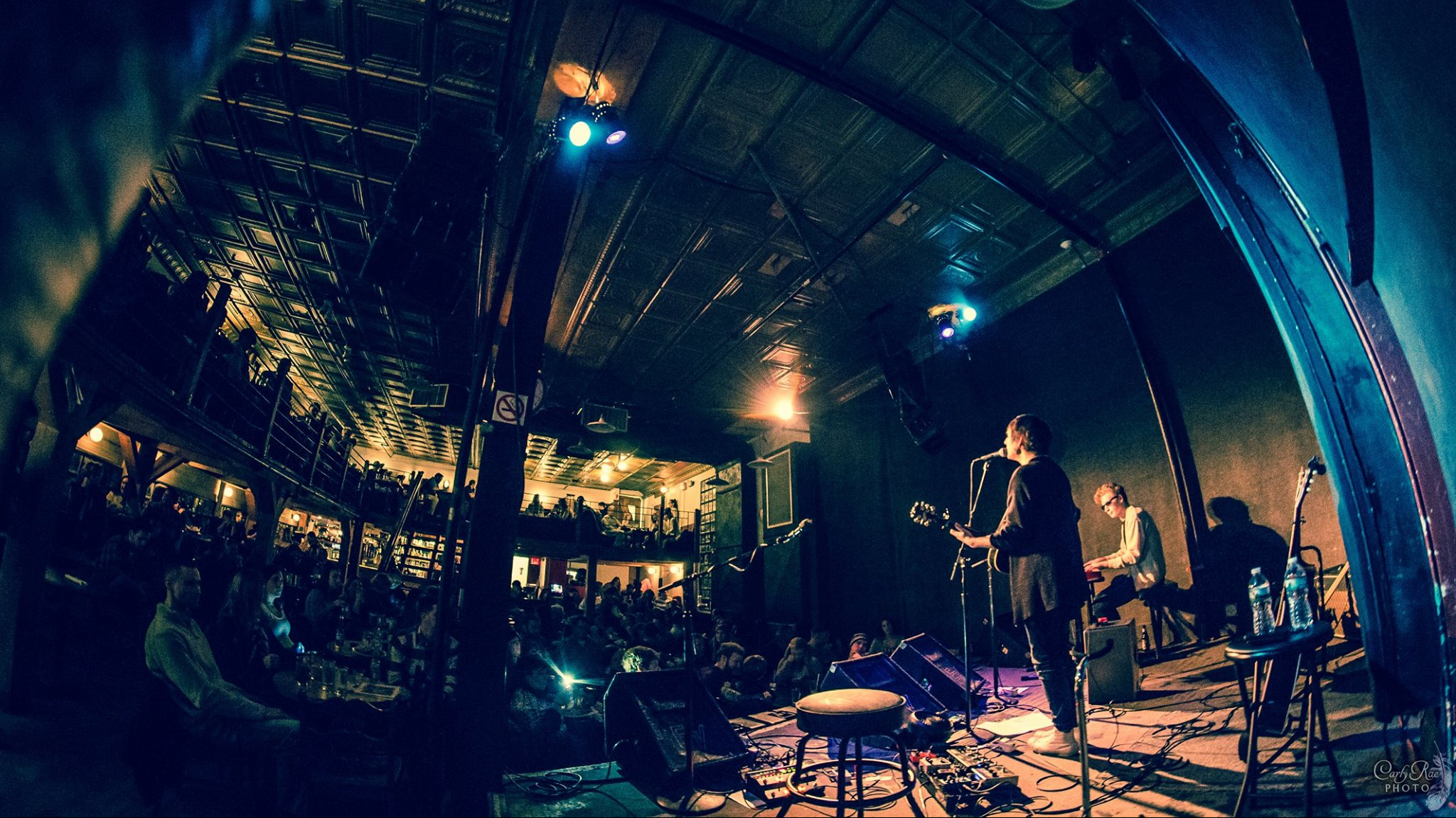
Willi Carlisle - The Universal Bubba Tour at The Iron Horse on Wednesday, November 4 2026
With a heavy-duty catalog of new material for a career first double album, The Universal Bubba marks a half dozen releases for folksinger Willi Carlisle and reaches new heights with the added accelerant of first time producer Tyler Childers. In an all-time DIY effort, Childers and his band convened to a makeshift home studio nestled in the Bywater District of New Orleans for two weeks to cut 17 tracks that expand Carlisle’s sonic scrapbook and capture the off-kilter characters living in his songs.
“I think this one goes to outer space,” says Carlisle. “I think this is the widest range of influences that I’ve ever had. It touches on funk, it touches on Americana, Cajun, oldtime, and experimental music.” With Childers’ band behind him, Carlisle embraced the freedom to wander across genres both familiar and new, testing out instrumentation and toying with the surreality of traditions being turned on their head. “It feels like getting drunk at the Civil War reenactment, or cruising at the cattle auction, or doing molly at the square dance,” says Carlisle. “It’s the first time I’ve ever used synthesizers and double electric guitars. There’s also more fretless 19th century style banjo on it than any record I’ve ever made.”
Exploration aside, Carlisle’s mission as a folksinger largely remains the same - documenting the stories and struggles of the people and balancing the humor and hope of existence. “I want to make a universal folk music. Songs for all kinds of weirdos,” says Carlisle. “With the idea that there is nobody that doesn’t have folk songs and everyone deserves folk songs. I want to write songs that prove the old weird America didn’t go anywhere, that we are living and dying for it everyday. I believe there’s noble work to do in that context. That if we feel despair, we don’t need to because there’s so much good work to do.”
Ever-working and ever-building, Carlisle’s can-do attitude for crafting songs comes in many forms on this album heavily inspired by the DIY ethos.
Filled with banjo and fiddle, album opener “The Mason Jar at the Center of the World” arrived well traveled - being written while on tour with Childers across six shows in Australia as the whispers of their collaboration were just beginning. Following a conversation with soon to be featured multi-instrumentalist Jesse Wells (affectionately called “The Professor”) about traditional musicians back home, completion of the track was aided by a snort of moonshine in an Australian motel room and an old poem from Wallace Stevens. “Smash three or four folk songs against a poem and add some hard traveling, you get a song,” says Carlisle. “Stuff’s intertextual like that.”
A top candidate for encapsulating the energy of The Universal Bubba, “Gas Station” is a driving recollection of life on the road with a sing-along chorus. Created largely on the fly and beginning with Childers’ joking about getting in a “knife fight at apple day,” the end result was Carlisle’s only co-write with his producer on the record. “We sat in a circle with pen, paper, instruments,” says Carlisle, “Tyler suggested, ‘goodle days’ instead of ‘good old days.’ We kept shaping verses, agreeing that my choruses were working. Suddenly I realized, this was a co-write! But the red light was already on. We were co-writing and recording at the same time. Wild as hell.”
The first half of The Universal Bubba contains the blistering ballad about hard work and hard fought love in “Use Me Up,” the honky-tonk nighthawk salutation of “Good Morning, Midnight,” and the rocking of “Hare-Krishnuts” on the absurd and smoky groover “Marlboro Vinyasa.” “Yoga breathing exercises and cigarettes,” says Carlisle. “What an American thing, to find the wheel of samsara in a pint glass!”
Just before the flip side lie the anarchist anthem “The Master’s Hammer” and superbly sinister “Contact High.” Of the former, Childers wanted a pure, essential folk song ringing out with harmonica, banjo and three part harmonies. ”I’m trying to boil my ideology down into something I can sing for my friends, a kind of reminder of who you’re trying to be,” says Carlisle.
Serving as the last gasp before intermission and first howl into the homestretch of the record, Carlisle introduces “the universal bubba” in two parts: “The Universal Bubba, Part One” - “for the booty-shakin’ rock and rollers and their pals” and “The Universal Bubba, Part Two” - “for the small town hell raisers, the unofficial mayors.”
“The universal bubba is somebody who can fix anything,” says Carlisle. “Somebody who is good for just about anything. Everywhere I go I meet these giant people - and what I mean is these men and women and folks who can do it all themselves. Something that’s really struck me about traveling around the world is that everywhere you go there are people who are tirelessly working to make things a little bit better without succumbing to modernity’s pitfalls. They’re somebody who has enough, and if it wasn’t enough they would make it enough.”
Intended to give glory to the spirited do-it-yourselfers corralling their own cosmos into being, the title tracks’ characters are not far off from Carlisle’s accomplishment with this project.
“This is the sort of person I want to be, and is the reason I’m a multi-instrumental folk singer with a lot of influences,” says Carlisle. “On this record I’m playing banjo, guitar, fiddle, harmonica. Writing out honky-tonk songs, proper folks songs, stuff like that - I want to be able to do it all myself and be in touch with the kind of music that universal bubbas might be interested in.”
With plenty of room to stretch across styles, The Universal Bubba continues with songs of great embellishment and somber tales on its latter half. “She Only Loves Horses” is a comical but forlorn Western about unrequited affection for a horse-obsessed woman. Sticking to the deepest depths of his folk roots, “Ditchdigger’s Song (Dust and the Devil)” is Carlisle’s ode to unskilled labor and self-prescribed spirituality.
“During twelve hour shifts of backbreaking and boring work, you’d get to talking, and I’d find that a lot of these guys had peculiar ideas,” says Carlisle. “Paganisms. A kind of Kabbalah. Cold beer and the apostles, pop country and bootstraps. I saw a guy kill a rattlesnake and take it home to eat it and absorb its power. I saw a guy singing to make it rain, and I knew a guy who recited dirty limericks to me daily. I wrote this from their perspective.