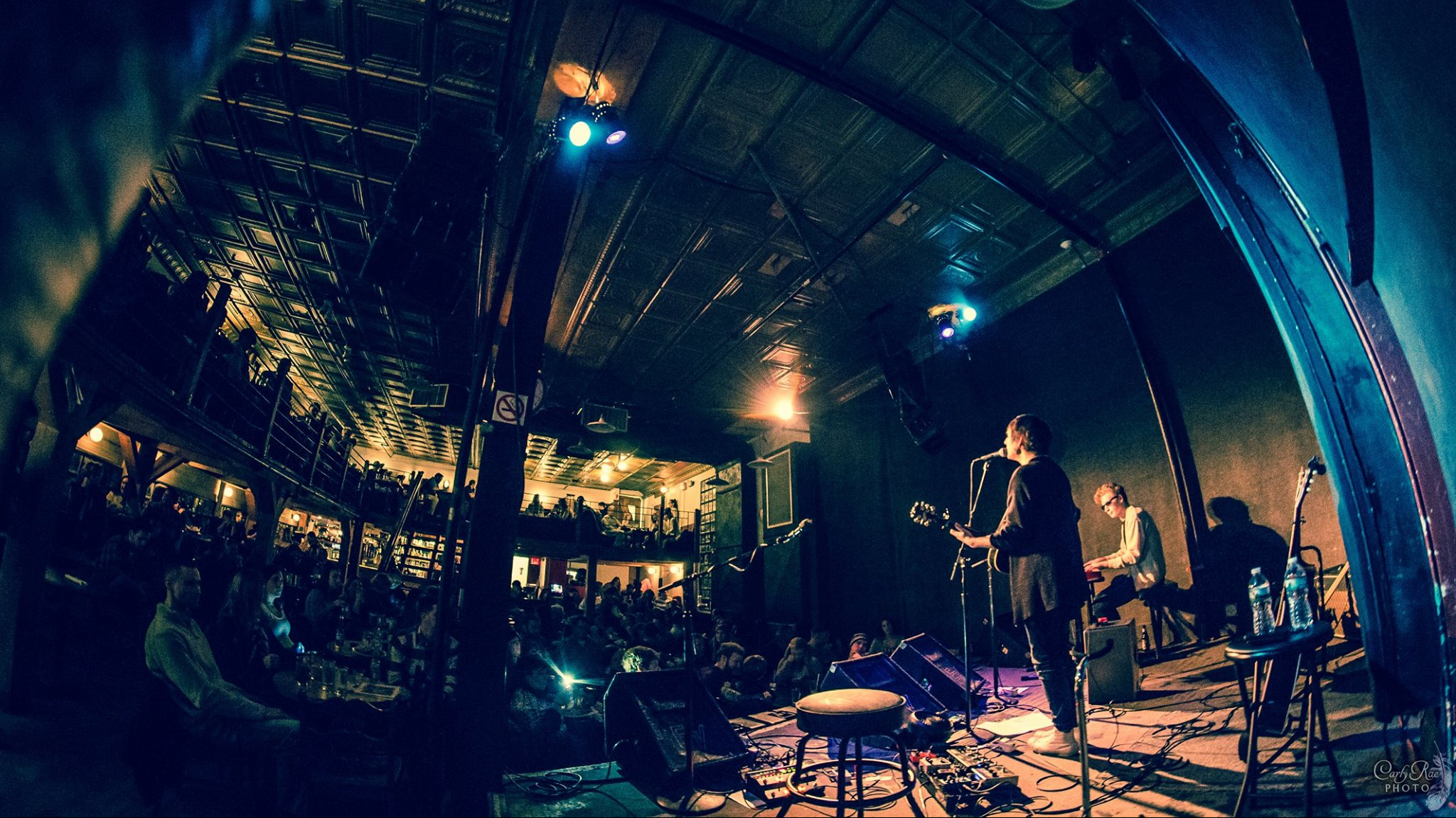
The Felice Brothers w/ Nic Panken at The Iron Horse on Thursday, April 30 2026
In the Valley of Abandoned Songs, hope and joy sit side by side with fear and sorrow. As you stroll amongst the wildflowers and tombstones that dot the landscape, you’ll pass innocence and shame, faith and despair, loneliness and love. You’ll feel the warm glow of the morning sun and the chilling darkness of impenetrable shadow. You’ll slip from the present into the past, from reality into dreams, from life into death and maybe, just maybe, back into life once more.
“There’s a tightrope walk between light and dark in these songs,” says Ian Felice, “between the magical wonder of existence and the ever-present sense of impending doom that comes with it. This album is my way of reconciling those things.”
Valley of Abandoned Songs, The Felice Brothers’ captivating new album and debut release for Conor Oberst’s new Million Stars label, is more than just a personal reckoning, though; it’s a deep and incisive meditation on what makes us human, on the search for meaning and connection as told through the eyes of a wide-ranging cast of misfits and outcasts. There’s the nightclub singer with blood on her hands; the heartbroken drifter watching the world through the slats of a boxcar; the regretful bellhop crying at the Ritz. Each is a loner struggling to find their way through a world that’s both devastatingly cruel and achingly beautiful, a restless searcher with a sharp eye for subtle detail and a penchant for thoughtful reflection. Felice invites us to walk a mile in their shoes—sometimes through the plainspoken narrative voice of a Southern Gothic writer, sometimes through the abstract expressionism of an avant-garde painter or poet—and while the recordings here span a variety of sessions across a period of several years, the result is a remarkably cohesive collection that manages to feel utterly timeless and particularly attuned to the present moment all at once.
“A lot of these songs are amalgamations,” Felice explains. “The settings can change from verse to verse and scene to scene. I don’t necessarily know who these characters are or where they come from, but they all evoke something very real in me.”
That balance of mystery and familiarity has been central to The Felice Brothers’ identity ever since they first emerged from the Hudson Valley nearly two decades ago with a gloriously ramshackle sound that drew on everything from Woody Guthrie and Bob Dylan to Walt Whitman and Flannery O’Connor. In just a few short years, the group went from busking on subway platforms and sidewalks in New York City to playing Radio City Music Hall with Bright Eyes and appearing everywhere from the Newport Folk Festival to Levon Helm’s Midnight Ramble. Beginning with 2007’s Tonight At The Arizona, the band helped pave the way for the modern folk revival, while at the same time challenging its boundaries and conventions with bold sonic experimentation and unyielding integrity. The New York Times likened their music to “the rootsy mysticism of the Band,” while Rolling Stone praised the “scrappiness” of their “folk-rock noir,” and The Guardian hailed their songs as “impeccably crafted, with literary-minded lyrics that are both playful and profound.” Over the course of nine studio albums, the group shared bills with everyone from Old Crow Medicine Show to Mumford & Sons, took their intoxicating live show to Coachella, Bonnaroo, Outside Lands, and countless other festivals across the US and Europe, and backed up Conor Oberst extensively in the studio and on the road.
It was Oberst, in fact, who ensured that Valley of Abandoned Songs received a proper release.
“A few years ago, I started revisiting old demos that had never seen the light of day and recordings that hadn’t found a home on previous albums,” Felice explains, “and I started thinking of them as the Valley of Abandoned Songs. At a certain point, I realized that I had a particular group of tunes that worked really well as an album, and so I shared it with Conor, along with my idea to post it on online, but he immediately texted back that he loved it so much he wanted to start a new record label just to put it out.”
The tracks Felice had pulled together came primarily from sessions for the band’s 2019 album, Undress, as well as their most recent release, 2023’s Asylum On The Hill, both of which were captured live in an 1870s church with the band’s current lineup (Ian on guitar/lead vocals, James Felice on keyboards/vocals, Jesske Hume on bass, and Will Lawrence on drums). The tunes were misfits and outcasts in their own right—some had gone unfinished in the moment, others simply didn’t match the overarching feel or themes of those particular records—and the recordings were left intentionally raw and unvarnished.
“I’ve always been drawn to artists who are willing to pull back the curtain,” Felice reflects. “When there’s that private, unguarded quality, I often find it easier to relate to the work.”
Intimacy has always been a hallmark of The Felice Brothers’ sound (they’ve recorded albums in a chicken coop, after all), but Valley of Abandoned Songs feels more exposed than perhaps anything else in their catalog. That’s not to say the songs aren’t fleshed out here—smoky album opener “Crime Scene Queen” features gospel back-up singers and a lush, full-band arrangement—but the performances are infused with the kind of loose and spontaneous energy that can only come from the act of making art for art’s sake, from being fully and completely immersed in the moment. The breezy “Flowers By The Roadside” finds an almost Buddhist contentment in sitting still and watching the world roll on, while the freewheeling “Younger As The Days Go By” makes peace with how little we ever really know about life, and the enigmatic “New York By Moonlight” finds simple pleasures in unexpected places: a startled flock of pigeons, a prostitute in pastel tights, a plume of exhaust hanging over a damp city street.
Not all residents of the Valley of Abandoned Songs are quite so enamored with their observations, though. The narrators of the galloping “Black Is My True Love’s Hair” and bittersweet “Stranger’s Arms” reckon with the hollow feeling of searching for something that can’t be found; the nursery rhyme nature of tunes like “Birdies” and “Racoon, Rooster And Crow” belies their grim reminders of mortality and loss; and the apocalyptic imagery of tracks like “Let Me Ride Away With The Horsemen” and “It’s Midnight And The Doves Are In Tears” reveals a profound disillusionment with the state of mankind. “From the jawbone of a donkey / To the atom bomb,” Felice sings. “Science and progress / What have you done?”
“There’s a persistence to the cruelty that goes on in this world,” he reflects. “I think the frustration and the pain of it weighs on all of us at times.”
Though his characters feel it acutely, Felice ultimately refuses to surrender to the weight of hopelessness on the record. The tender “Tomorrow Is Just A Dream Away” insists on believing in the possibility of something better, even as our bloody history repeats itself over and over again, and album closer “To Be A Papa” pledges unconditional love in an unpredictable world. “Stay with me / For the road is long / And the winds are strong,” Felice declares. “And I’ll stay with you.”
In the Valley of Abandoned Songs, it turns out, nothing gets abandoned after all.
Nic Panken understands the perseverance of art and its intentions to ground and inspire us. He sees how melodies ruminate deep in the belly of uncertainty, blossoming to bring fresh clarity and a whispering optimism. Over the years, the Brooklyn-born songwriter has endeavored to spread the invigorating presence of song, initially through fronting the Americana-folk group Spirit Family Reunion and now, through his own evolution as a solo artist. Panken strives for equilibrium and purpose, and it's through his gorgeously sensitive yet gutsy delivery that an exhale can be found, away from our amplified anxieties and collective mourning.
Now residing in Kingston, NY, Panken divides his time outside of music-making between working as a puppeteer, hosting his weekly radio show, and mixing sound at beloved local venue Tubby's. By immersing himself in the restorative power of the arts, every day is decorated with the potential to be present; to find new meaning and community through his various, purposeful practices. After years of relentless touring with Spirit Family Reunion, Panken found solace in staying still, and it’s in this shift that he began crafting what would become his new body of work.
His debut solo album Near Divine or Merely Rhyme is the result of trusting your gut and the process, no matter how unexpected the outcome. The foundation of these songs were spurred on by a wink from the universe, when Panken met multi-instrumentalist Jared Samuel (Kevin Morby, Aldous Harding) while performing at a local Hudson Valley house show. Samuel and his partner Sarah La Puerta run the small recording studio Pale Moon Services in Cambridge, NY, with core beliefs that music making is for all, and that to say yes to one instant is to say yes to all of existence. “As soon as I walked into that space I knew I wanted to make music there,” Panken says, citing Samuel’s “encouraging yet patient,” energy that served as a catalyst in the album’s tapestry. The previously stripped-down arrangements of Panken’s songs soon morphed into an expansive landscape, as the pair’s chemistry propelled the sonic direction. “I learned to just allow it to be what it wants to be.”
Panken multi-tracked harmonies with himself for the first time, and used many of the synths and keyboards dotted around Samuel’s studio. “My music has always been very grounded in Earth, but there’s also something cosmic that is starting to emerge,” he says. On Near Divine or Merely Rhyme, Panken strives for a connection between the terrestrial and the celestial. “Delightful Dust,” a love song that faces the hard truths of inevitable change, burns with a driving fiddle accompaniment. He had played a show backed by a new band in the middle of writing it, which he now realizes underscored a permission that he can also write from a place of energy, alongside quiet introspection. The vitality surrounding “Delightful Dust” went on to inform many of the sonic structures of the record, as Panken explored collaboration and unfiltered creation.
Panken invited his old bandmate Mat Davidson (Twain) to play throughout the album, and it’s on the tender collage of “Deep Time” that both the comfort of what you know and the anticipation of what you don’t collide. The pair hadn’t played together for years, so they set up a couple of mics, faced each other and just let what was going to happen, happen. This raw, spontaneous approach highlights Panken’s ability to capture the fleeting nature of experience, and the pain and beauty that that entails. He continued experimenting with “Dear Companion,” when he and Samuel cut up the lyrics and melody, piecing them back together like a jigsaw. It’s a model of memory, of how we try to make sense of our own stories by trying to see every shape, and every angle. “Like a sculptor, the work is to shed layers until the most potent inner form is revealed,” Panken says. Known for his ardent, belting vocals with Spirit Family Reunion, “Dear Companion” taught Panken that he can sing with more subtlety––a whisper rather than a soar––and encouraged him to get comfortable with being vulnerable.
Near Divine or Merely Rhyme is an artist searching for meaning, in all the facets and corners of everyday life; it’s a story of wanting to be seen but feeling apprehensive about being perceived, and of trying to embrace many truths at once. It was during the process of making this album that Panken understood there is no truth necessarily––it’s all just dust in the end––but that doesn’t mean we can’t experience meaning. “But even if you’re just some delightful dust, You bring essence that I savor,” he laments on “Delightful Dust,” pointing to the impact of others and our surroundings on who we ultimately become. These songs are an attempt to be present, to experience it all despite the pain or the sorrow, and to delight in the ambiguity of a widening horizon.